
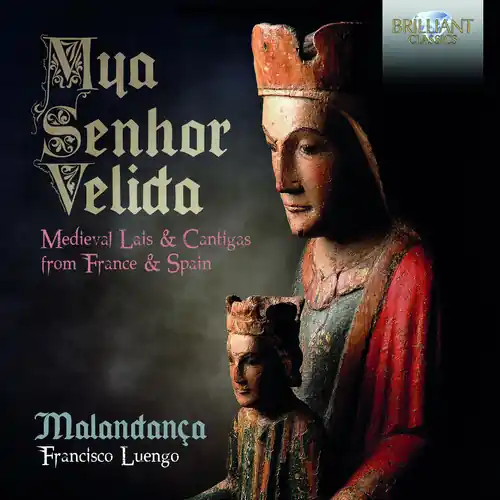
Mya Senhor Velida Reduced Price
Original price was: $13.99.$7.00Current price is: $7.00.

For orders under $59.00, a shipping fee of $12.99 applies.
DISC: 1
| 1. Plainte De La Vierge Au Pied De La Croix |
| 2. Santa María Loei, E Loo E Loarei |
| 3. Recordare. Antifona Para El Ofertorio En La Fiesta De Maria Mediadora |
| 4. Nembressete Madre De Deus, Csm421 |
| 5. Lai De Notre Dame |
| 6. Virgen Madre Groriosa, Csm340 |
Powered by Broadtime Tuneportals
More Info:
These medieval cantigas and lais – troubadour compositions from Galicia and France, respectively – display an innovation of the 12th and 13th centuries: themes of courtly love and Marian devotion combined, at once carnal and mystical, encompassing both the profane and the divine. The two lais on this recording are found in a manuscript songbook known as the Noailles Chansonnier from c.1300. In the anonymous Plainte de la Vierge au pied de la croix the Virgin Mary speaks in first person in a figurative lament at the foot of the cross. The Lai de Notre Dame, attributed to 13th-century troubadour Ernoul ‘Le Vieux’ or ‘Le Vielle’, begins with the author’s promise to keep faith with the Virgin Mary and serve no other woman, a pledge quite reminiscent of those of Alfonso X of Castile in his Cantigas de Santa Maria, one of the largest collections of monophonic songs from the Middle Ages. The Cantigas, attributed to King Alfonso X (1221-1284), were written in early-Medieval Galician-Portuguese, fashionable as a lyrical language in Castile at the time. In Santa Maria loei, e loo e loarei, the king thanks the Virgin Mary for her kindness and protection. Nenbressete, Madre de Deus deals with Mary’s role as mediator – in medieval eyes, her primary function. It was composed as a contrafactum on Recordare, translating the antiphon into Galician-Portuguese and expanding it with new musical and poetic concepts. Virgen Madre groriosa, a contrafactum on the estampie ‘Reis Glorios’ by French troubadour Giraut de Bornelh, binds this album together, demonstrating the relationship between the Galician-Portuguese and French lyrics. To the members of Malandança, medieval music is a field in which both performance and scholarship are unavoidable and interdependent subjects. Research conducted by Francisco Luengo and others into sculptures depicting medieval instruments has opened up a world of sounds, ideas, images and voices from the distant Middle Ages.
Related products
-
Sale!

Exclusive Offer It's Impossible
Original price was: $0.97.$0.48Current price is: $0.48. Add to cart -
Sale!
New Release Christmas Album-Here We Come A
Original price was: $7.97.$3.98Current price is: $3.98. Add to cart -
Sale!
Fast Shipping Essential
Original price was: $9.97.$4.99Current price is: $4.99. Add to cart -
Sale!
Flash Sale All The Great Hits
Original price was: $11.97.$5.99Current price is: $5.99. Add to cart